Outside Dallas
LLC Quarterly Taxes, for Texas owners
Dallas is where this practice works, the call is a video call for an owner whose company is outside Dallas and Fort Worth, and we are all Texans on that call while a Comptroller envelope sits beside the federal voucher.
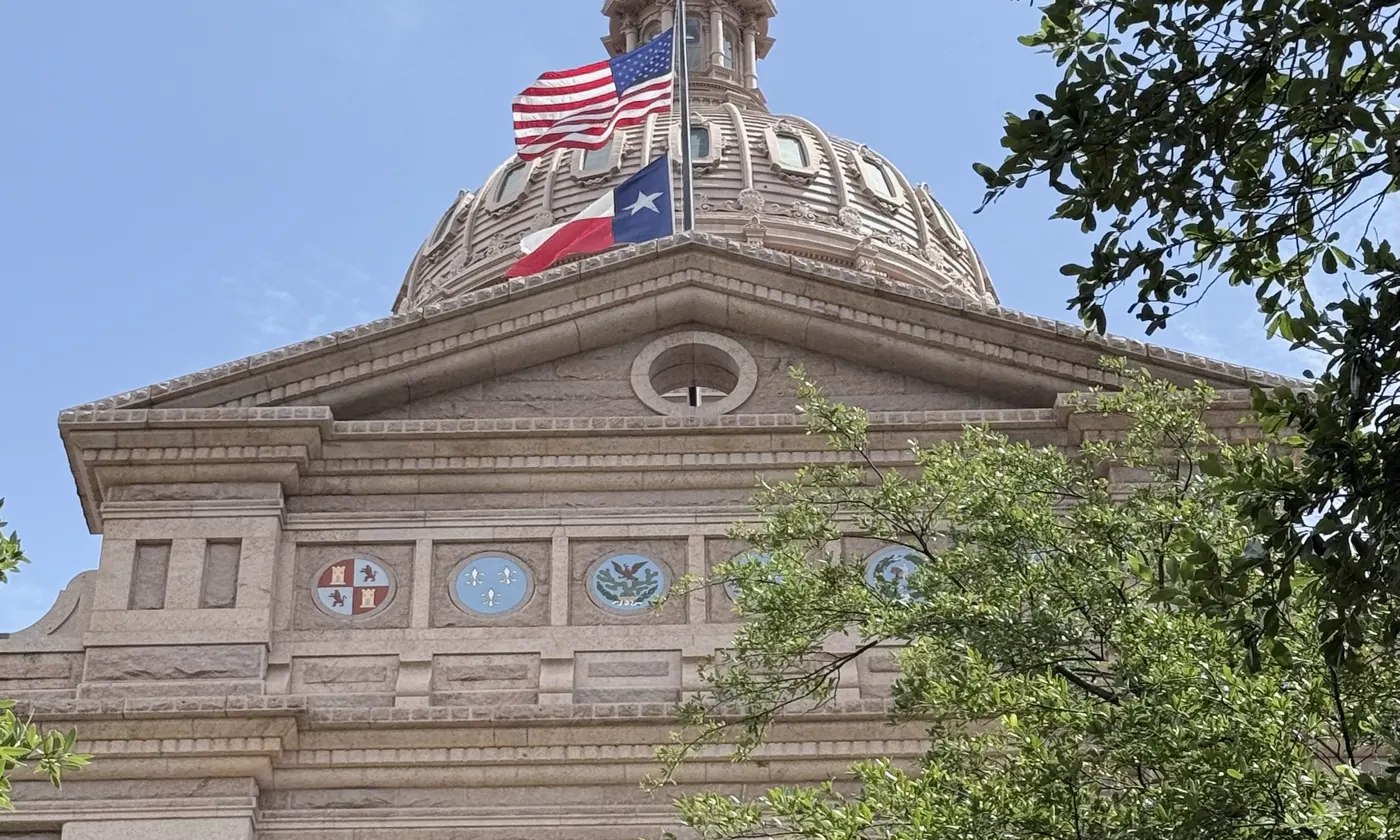
A photograph, not a bench.
Farragutful made the photograph of the Texas State Capitol dome in Austin that opens this page, and the license on that frame is CC BY-SA 4.0. Those steps stay inside the picture. This practice does not add a bench in the town that holds the company's books.
Put the Comptroller envelope on the same table as the federal voucher you already know. Letterhead reading Texas Comptroller of Public Accounts is a state row. The election that chose April, June, September, and January never pulls that state row off the year.
The privilege tax, which the forms call the franchise tax, follows a company organized in Texas and also a company organized somewhere else that still does business in Texas. The filing list keeps an LLC, a one owner LLC, a series LLC, a corporation, a partnership, and an S corporation. Someone who never formed an entity, and who invoices only in a personal name, has no franchise report to set beside the federal voucher. The privilege tax pages are at comptroller.texas.gov/taxes/franchise/.
May 15 is the ordinary shared day for the franchise report and for the report that names the owners. May 15 moves forward when it falls on Saturday, Sunday, or a holiday the agency observes, and the franchise report uses that later weekday. Public information rides on Form 05-102. Ownership information rides on Form 05-167. Both forms share that day with the franchise report.
Tax Code section 171.0003 is the passive entity rule. That entity still sends the EZ computation or the long form. It skips the information report. A pre-qualified new veteran owned business may skip the information report through its first five years, and only while the qualification holds.
Rates for two report years.
A report that covers 2026, and a report that covers 2027, drops the privilege tax to zero when revenue sits at or under 2,650,000 dollars. On the long form, retail margin and wholesale margin are multiplied by 0.375 percent. A taxable company outside that retail or wholesale group is multiplied by 0.75 percent. Compensation can reduce one person's margin only up to 480,000 dollars. A vendor bill that never became wages cannot spend that cap.
Revenue at or under 20 million dollars lets the company, or its combined group, choose the EZ computation at 0.331 percent. That choice exists only when the filer gives up margin deductions, gives up credits, and gives up that year's temporary credit for a business loss. The long computation is Form 05-158. The shorter computation is Form 05-169.
Members of one combined group lock a single margin method. The menu has four choices, and the order we write them for a voucher owner is seventy percent of revenue, then revenue after the cost of goods sold, then revenue after compensation, then revenue after a flat 1 million dollars. Start from the revenue figure the federal return already shows, and then let the statute pull back items the margin is not allowed to keep. Cost of goods sold means property the company sells. A leftover supply in a drawer is a different pile.
The compensation subtraction takes W-2 wages and cash pay to officers, directors, owners, partners, and employees. Net distributive income paid to a natural person is inside that subtraction. Certain benefits are inside it. Labor billed on a 1099 stays outside it. The payroll tax the company itself paid stays outside it. Apportionment is a receipts fraction. Gross receipts from Texas are the numerator, the rate multiplies only the margin that survives that fraction, and margin against receipts from other states stays outside the multiplication.
Beginning with the 2024 due season, sitting at or under the no tax line removes the franchise tax report from the stack and leaves the information report in the stack. Show up after the franchise due day and the bill includes a flat fifty dollars. A zero on the tax line does not erase that flat charge. Pay the franchise tax inside the first month after it was due and the added charge is five percent of whatever tax the report shows. Tax paid after those thirty days adds ten percent of the tax. On the franchise side, the interest clock starts on day 61, which is a different worry from the flat late charge that starts the day after the due day. Write 7.75 percent in the margin of a 2026 Comptroller bill when the page says most taxes draw prime plus one, and do not borrow an older year's percent for a voucher you are dating now. An extension payment smaller than the required amount leaves a gap, and penalty plus interest run on that gap even when the report itself arrives on the extended day.
When the company is ending.
An information report that never arrives can cost the company the right to sue or to defend a case in a Texas court. The same gap can place certain debts on officers, directors, partners, members, or owners as personal debts. Banks and other financial institutions sit outside that personal debt reach. We will not describe a wider reach than the statute gives.
A certificate of account status is the paper a buyer often asks for before a deal. Ending, converting, or merging a Texas company is blocked at the certificate of account status until the last franchise report is in and the amount it shows is paid. Nexus that ends, for a company that was organized in another state, starts a sixty day clock for the last franchise report.
November 15 is available as the pushed franchise day only while the company is still allowed to pay without electronic funds transfer. After franchise tax paid in the prior state fiscal year reaches 10,000 dollars, the payment method becomes electronic, with one window in August and a second window in November. The 2026 chart already prints those windows as August 17 and November 16. Extra time exists when an online payment, or Form 05-164, reaches the agency by the original due day. What has to be paid is generally the whole of last year's tax, or ninety percent of this year's tax. A filer who is not on electronic funds transfer should read the tighter line on the extensions page. A first report has no whole of last year choice. A company that just left a combined group has no whole of last year choice either.
Payment code 13080 is the TEXNET transfer that itself asks for the extra time. In that case Form 05-164 stays unmailed. The federal voucher already has its own four dates, and this transfer uses a different clock. The transfer has to land before 8 pm Central Time on the business day that comes before the franchise due day.
A paper check remains a way to pay while the tax is under 10,000 dollars. Cross 10,000 dollars of franchise tax and a paper check stops being a permitted way to pay the Comptroller. A franchise payment of 500,000 dollars or higher can travel only on TEXNET, with no alternate electronic rail and no check. Webfile can carry the information report, and a mailed copy can go to the Austin box the Comptroller page prints. Leave that box on the agency page, because this practice does not use it as an address. The signature line on the report wants the company's legal name.
A second calendar for sales.
Closing the franchise report leaves sales tax still open, on dates that do not match the federal voucher. The state piece is 6.25 percent. A city, a county, a transit authority, or a special purpose district can add local tax, and that local add on stops at 2 percent. State plus local stops at 8.25 percent. The place of the sale chooses which local pieces apply. The Comptroller rate locator answers one street address at a time. Writing a city's split onto this page would go stale, so no city split is frozen here.
A taxable sale is what triggers the permit. The formation filing and the sales permit are different envelopes, and finishing the first one never starts the second. The person who applies has to have reached age 18. When a sole owner, a partner, an officer, or a director has no Social Security number, the paper path is Form AP-201. Approval of the permit is not the end of the mail. The next Comptroller letter tells the seller which of three sales rhythms was assigned, and that assignment is what we write beside the federal voucher so the two calendars stay apart. The Comptroller pages in the library do not print the dollar figure that chooses that rhythm, so the figure stays off this page.
When the letter says monthly, the sales return for a finished month is due on the twentieth of the following month, which is a rhythm the federal voucher never uses. Quarterly sales dates are April 20, July 20, October 20, and January 20, which is a different January from the federal voucher a calendar year person already expects in the middle of that month. A seller the letter put on a yearly sales rhythm also aims at January 20, and that January 20 is not the mid January federal voucher. If a sales twentieth lands on Saturday, Sunday, or a holiday the Comptroller observes, file on the following weekday the office is open. Open the 2026 sales calendar and June, September, and December are already printed on the moved days, so do not recompute those three by hand.
Miss the sales due day and the Comptroller adds a flat fifty dollar charge on that sales return, separate from the percent that rides on the tax itself, and separate from the federal voucher that may fall in the same month. Tax paid inside the first thirty days after the due day adds five percent. Tax paid later than that adds ten percent. Interest begins after sixty days. A seller who files on time and pays on time may keep one half of one percent of the tax that was paid on time, and a prepayment lets the seller keep another 1.25 percent. The return those sellers usually complete is Form 01-114. The sales pages are at comptroller.texas.gov/taxes/sales/. Money a receipt labels as tax is money held for the state until it is sent, so count that amount outside income. Texas does not lay a tax on a wage the way a state income tax would, and that absence does not cancel the franchise report, the information report, or the sales return.
Where the letter sends you.
The Comptroller walk in list includes a Dallas Northwest room and a Dallas Southwest room, plus rooms in other cities. Counters are staffed three weekdays. Monday runs nine to four. Wednesday runs nine to four. Friday runs eight to noon. Tuesday and Thursday are not public counter days. The phone line for those counters answers Monday through Friday, opening at eight and closing at five. McAllen takes visitors by appointment only, and Waco does the same. Four cities on the Comptroller map, Fort Worth and Arlington and Plano and Frisco, show no public counter at all. An owner there either drives to a Dallas counter or uses the virtual field office. This practice does not sit with you inside those rooms.
On the video call, angle page one of the letter so the form number and the due day fill the frame. From that page we can separate the privilege tax, the information report, the sales return, and a permit, and we can say whether that due day still comes before the federal voucher already written on your calendar.
Name the Comptroller form.
A photo of page one, with the form number and the due day readable, is all the note needs.
You will be talking to the Steven Palmieri practice.